

04/08/2023
James Webb Space Telescope Captures Stunning Images of the "Ring Nebula" in Lyra
The James Webb Space Telescope (JWST) has recorded breath-taking new images of the iconic Ring Nebula (Messier 57). The images, released today by an international team of astronomers led by Prof. Mike Barlow (UCL, UK) and Dr. Nick Cox (ACRI-ST, France), showcase the nebula's intricate and ethereal beauty in unprecedented detail, providing scientists and the public with a mesmerizing view of this celestial wonder.
For many sky enthusiasts, the Ring Nebula is a well-known object that is visible all summer long and that is located in the constellation Lyra. A small telescope will already reveal the characteristic donut-like structure of glowing gas that gave the Ring Nebula its name. It is a planetary nebula, objects that are the colourful remnants of dying stars that have thrown out much of their mass at the end of their lives. The Ring Nebula’s distinctive structure and its vibrant colors have long captivated the human imagination. The stunning visuals captured by the JWST offer an unparalleled opportunity to study and understand the complex processes that shaped this cosmic masterpiece.
Prof. Mike Barlow, the lead scientist of the JWST Ring Nebula Project, expressed excitement about the findings: "The James Webb Space Telescope has provided us with an extraordinary view of the Ring Nebula that we've never seen before. The high-resolution images not only showcase the intricate details of the nebula's expanding shell but also reveal the inner region around the central white dwarf in exquisite clarity. We are witnessing the final chapters of a star's life, a preview of the Sun’s distant future so to speak, and JWST's observations have opened a new window into understanding these awe-inspiring cosmic events. We can use the Ring Nebula as our laboratory to study how planetary nebulae form and evolve."
The Ring Nebula's stunning features are a testament to the stellar life cycle. Approximately 2,600 light-years away from Earth, the nebula was born from a dying star that expelled its outer layers into space. What makes these nebulae truly breath-taking is their variety of shapes and patterns, that often include delicate, glowing rings, expanding bubbles or intricate, wispy clouds. These patterns are the consequence of the complex interplay of different physical processes that are not well understood yet. Radiation from the hot central star now lights up these layers.
Just like fireworks, different chemical elements in the nebula emit light of specific colors. This then results in exquisite and colourful objects, and furthermore allows astronomers to study the chemical evolution of these objects in detail.
"These images hold more than just aesthetic appeal; they provide a wealth of scientific insights into the processes of stellar evolution. By studying the Ring Nebula with JWST, we hope to gain a deeper understanding of the life cycles of stars and the elements they release into the cosmos," adds Dr. Cox, the co-lead scientist of the JWST Ring Nebula Imaging Project.
The international research team is composed of researchers from the UK, France, Canada, USA, Sweden, Spain, Brazil, Ireland and Belgium and are analyzing these images. “Stay tuned”, says Prof. Barlow, “JWST/MIRI images of the Ring Nebula are coming soon as well!”
The James Webb Space Telescope, a joint collaboration between NASA, the European Space Agency (ESA), and the Canadian Space Agency (CSA), has proven to be a game-changer in astronomy. Its capabilities go beyond what was possible with previous space telescopes, allowing scientists to peer deeper into the cosmos and explore new frontiers of the universe.
For media inquiries and interview requests, please contact:
Dr Griet C. Van de Steene , K.S.B., g.vandesteene@oma.be
Dr Peter A. M. van Hoof , K.S.B, p.vanhoof@oma.be
Images:
(click on the images for a bigger picture)
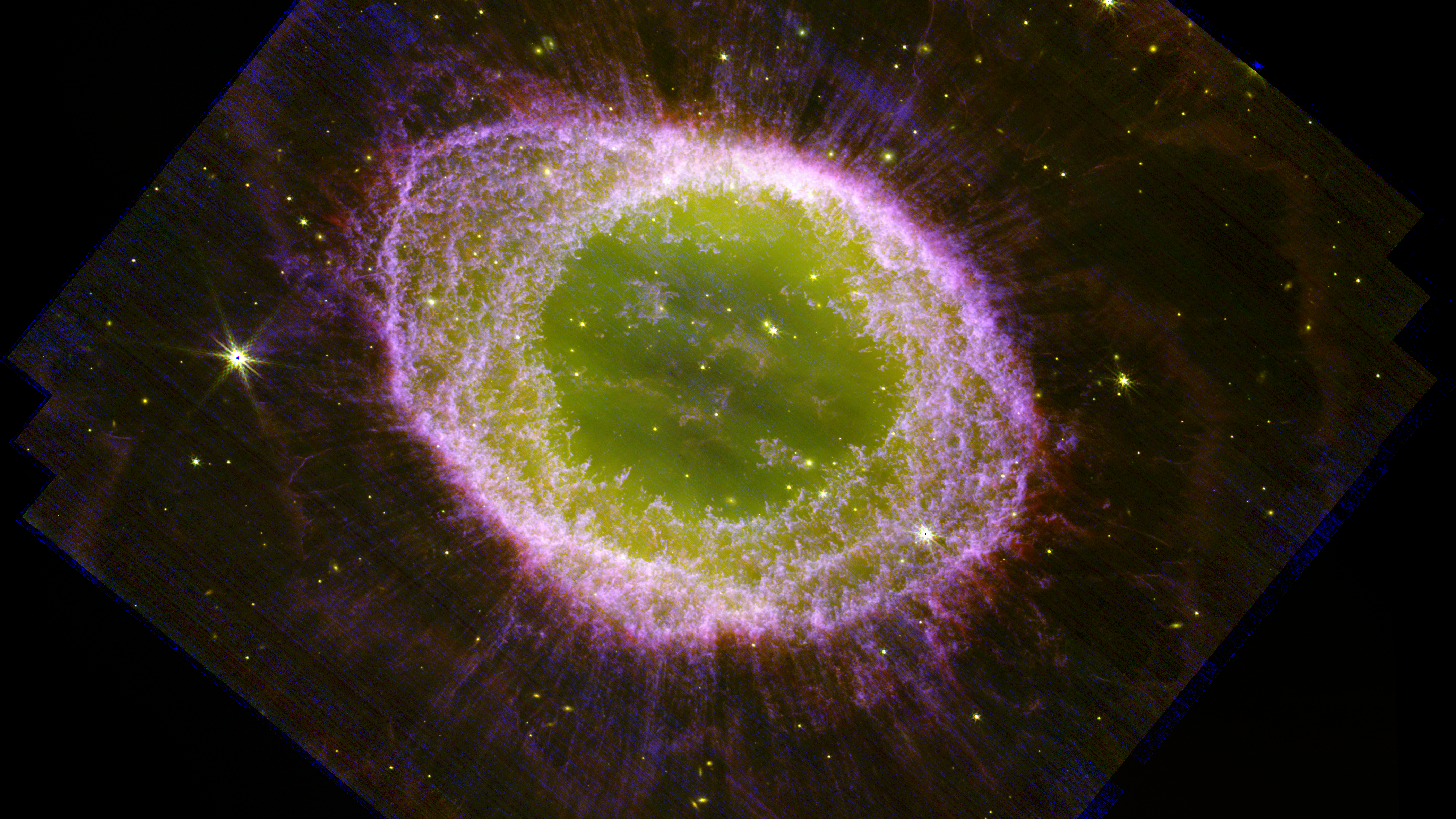
JWST/NIRCam composite image of the Ring Nebula. The image clearly shows
the main ring, surrounded by a faint halo and with many delicate structures. The interior of the
ring is filled with hot gas. The star which ejected all this material is visible at the very centre. It is
extremely hot, with a temperature in excess of 100,000 degrees. The nebula was ejected only
about 4000 years ago. Technical details: The image was obtained with JWST's NIRCam
instrument on August 4, 2022. Images in three different filters were combined to create this
composite image: F212N (blue); F300M (green); and F335M (red).
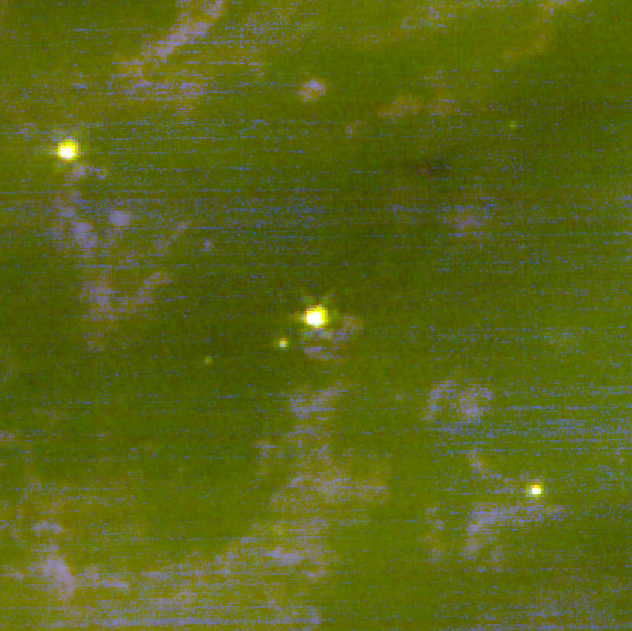
close-up of the central parts of the image. The brightest star here is the dying
central star. It has used up all its fuel and is now cooling down. The star will become a white
dwarf, an inert remnant of a star. The fainter stars in the image are not related.
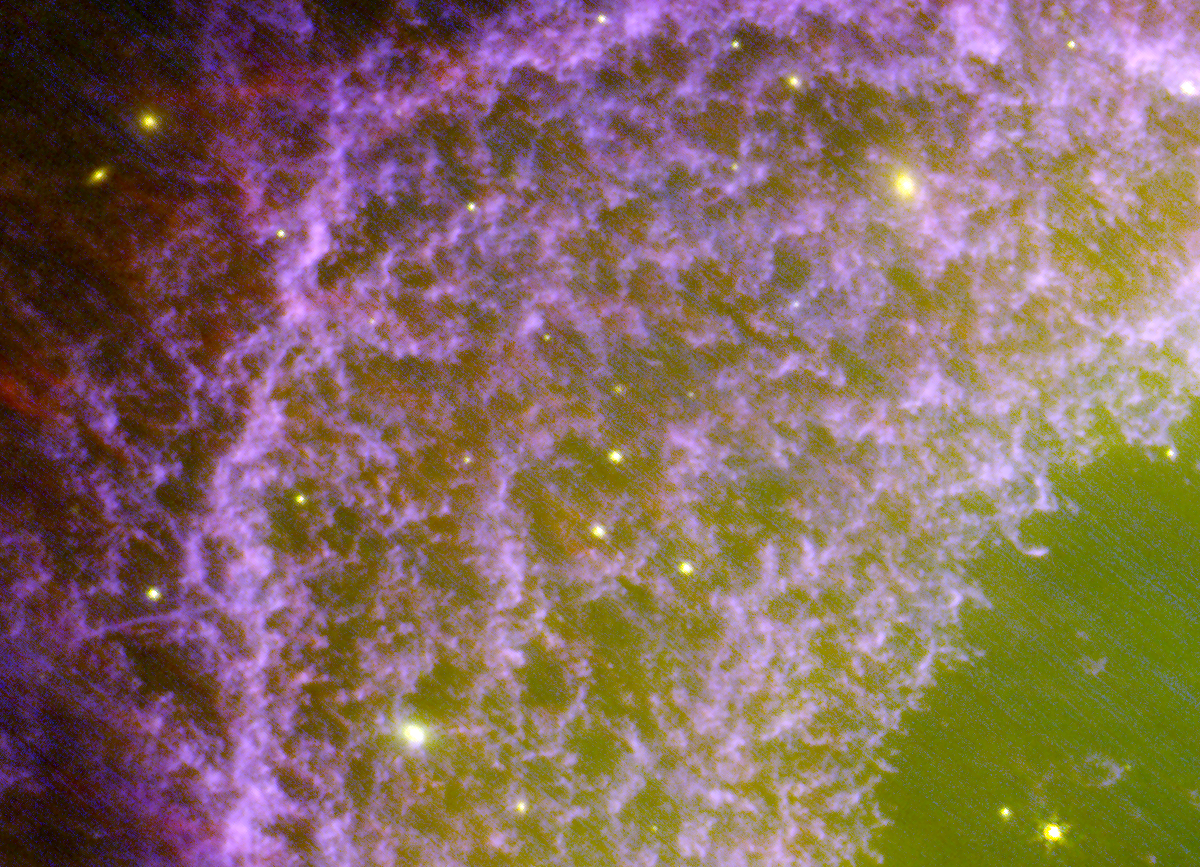
A close-up of part of the nebula shows that the ring consists of large numbers of
small clumps. Clumps are small regions in the nebula that are much cooler and denser than the
rest of the nebula and contain molecular gas. Some of the clumps are beginning to develop tails
(see e.g. at the lower right), behaving as comets the size of planets. The team counts as many
as 20,000 clumps and estimates that about half of all gas in the nebula is in these clumps.
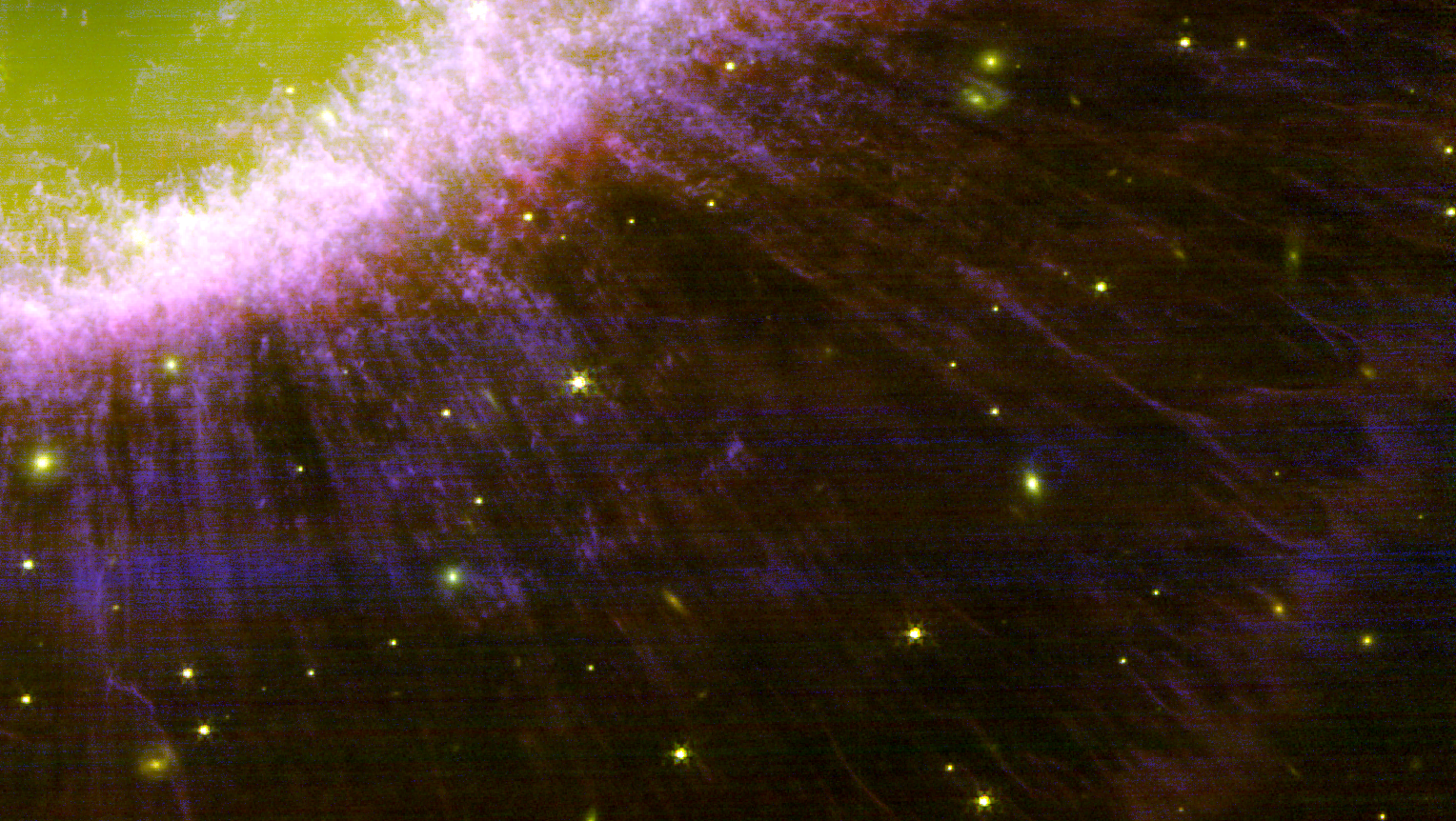
close-up of the southern part of the outer halo, the part outside the main ring.
The team finds several hundred linear features, referred to as ‘stripes’, pointing approximately at
the central star. Their origin is not yet clear. How a single star can create such a complex
nebula is not well understood. JWST will be used to study the structure, and the origin of the
clumps and stripes. In the background, thousands of more distant, numerous faint galaxies can
be seen in green, some with clear spiral structure.
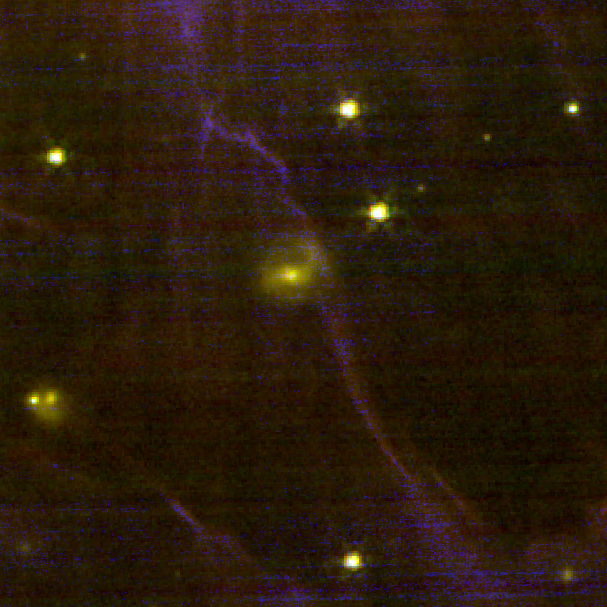
A further close-up of the halo, showing wisps, where hot gas is blowing into the halo and
sweeping up the material there.
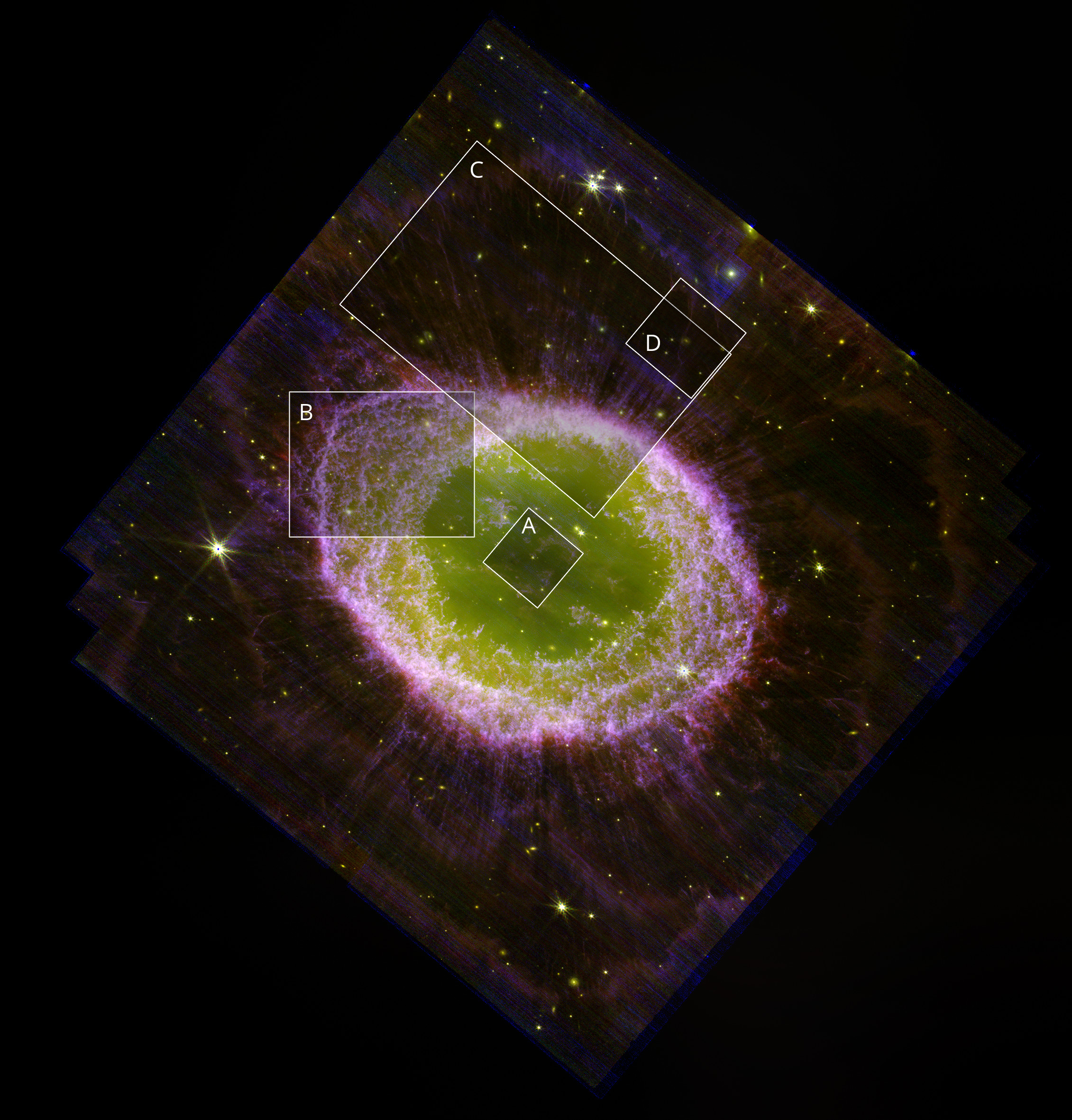
the full field of view imaged with NIRCam, with boxes to indicate the locations of
fields highlighted in figures above. Region A shows the central star; region B highlights the
thousands of dense clumps in the main ring; region C shows the radial “stripes” which appear in
the outer halo; and region D shows wisps of gas still further out.
Video :
copyright : NASA/ESA/CSA Roger Wesson and the Ring Nebula team